
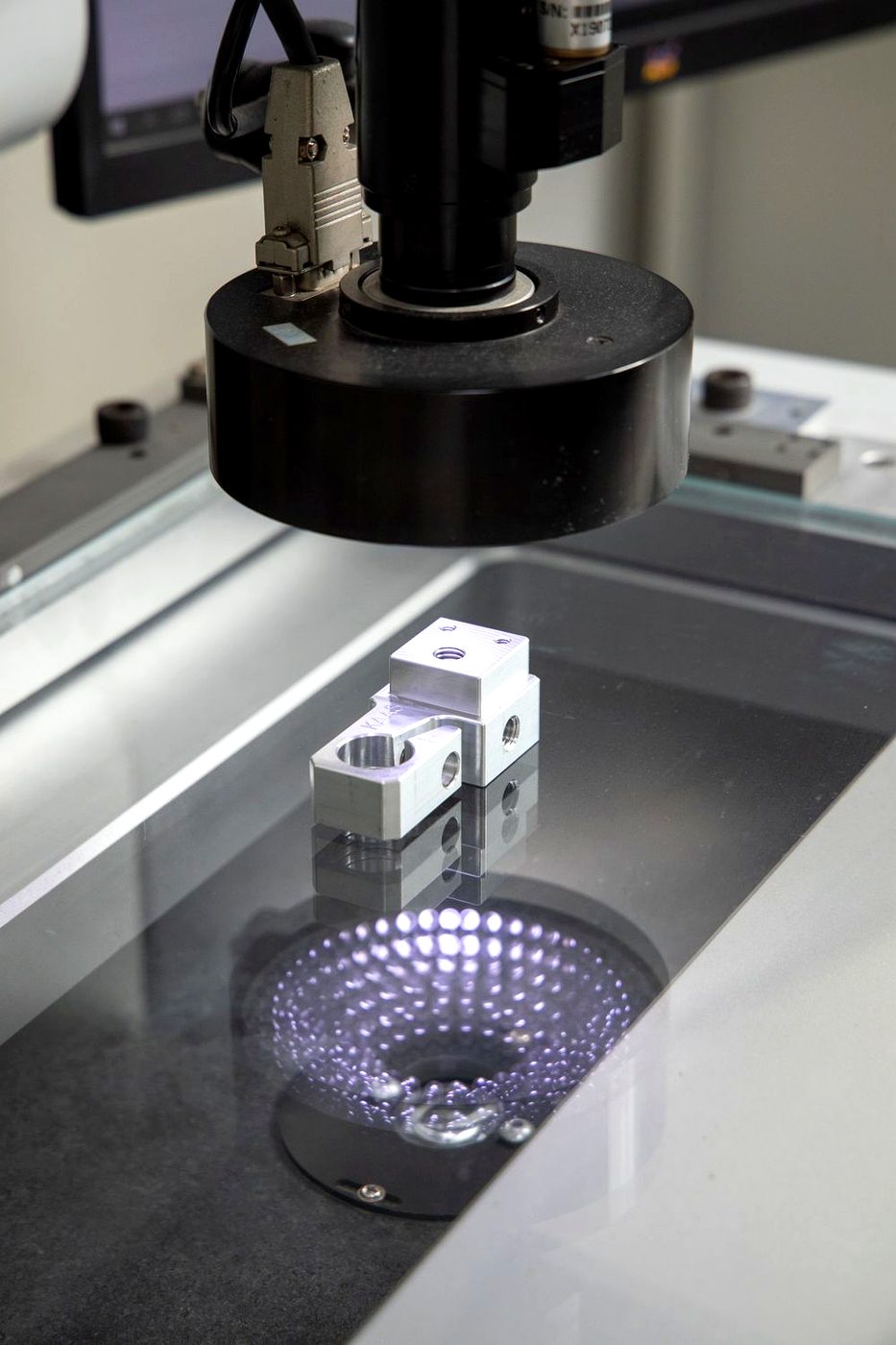
Independently tested
The metal,
measured.
Composition, hardness, tensile strength, conductivity and restricted substances — tested by an independent laboratory, with the report numbers published so you can quote them back.
Material verification, in full
Anyone can type "6061 aluminium" into a listing. We had our metal analysed by an independent laboratory and we publish the measured numbers, the method, and the report numbers — so you can check instead of believe.
6061 is a specification with defined limits for eight elements. Our metal was tested against those limits by SGS and every element falls inside them — with the impurity-indicator elements sitting far below their maximums, which is what primary rather than heavily recycled metal looks like.
The same material has also been tensile tested to ASTM B557-15. It came back at 52 ksi tensile and 50 ksi yield against specification minimums of 38 and 35 — not scraping a pass, but 37% and 43% clear of it.
So the metal is genuinely 6061, and it is genuinely at full T6 strength. What that still does not prove is that any given terminal cannot be broken — we are explicit about where the evidence stops, further down.
Why the alloy matters on this particular part
A battery terminal looks like a simple lump of metal, which is why it gets treated as a commodity. It is not one. It is clamped under load around a tapered post, it carries the highest current anywhere in the vehicle, and it spends its life hot, vibrating, and surrounded by acid vapour.
That combination makes it a mechanical part as well as an electrical one. The body has to hold clamping load for years without deforming or cracking. When a terminal body fails, the consequence is not a slow degradation — it is a connection that lets go, on a moving vehicle, at the point where every circuit in the car is fed.
Alloy composition is the foundation of that mechanical behaviour. It is also the single easiest thing to misrepresent, because the finished part looks identical either way.
What "6061" is supposed to mean
6061 is not a marketing word. It is a specification that sets permitted ranges for eight alloying elements. Metal outside those ranges is not 6061, regardless of what the listing says.
The two elements that do the real work are magnesium and silicon. They combine to form magnesium silicide, the precipitate that gives the 6061 family its strength when heat treated. Get those wrong and you have aluminium that machines like 6061 and looks like 6061 but cannot reach its strength.
Three elements act as impurity indicators. Iron in particular enters aluminium through steel contamination in scrap, and is very hard to remove once in the melt — so heavily recycled material tends to run high in iron. Zinc and titanium behave similarly.
What our metal actually measured
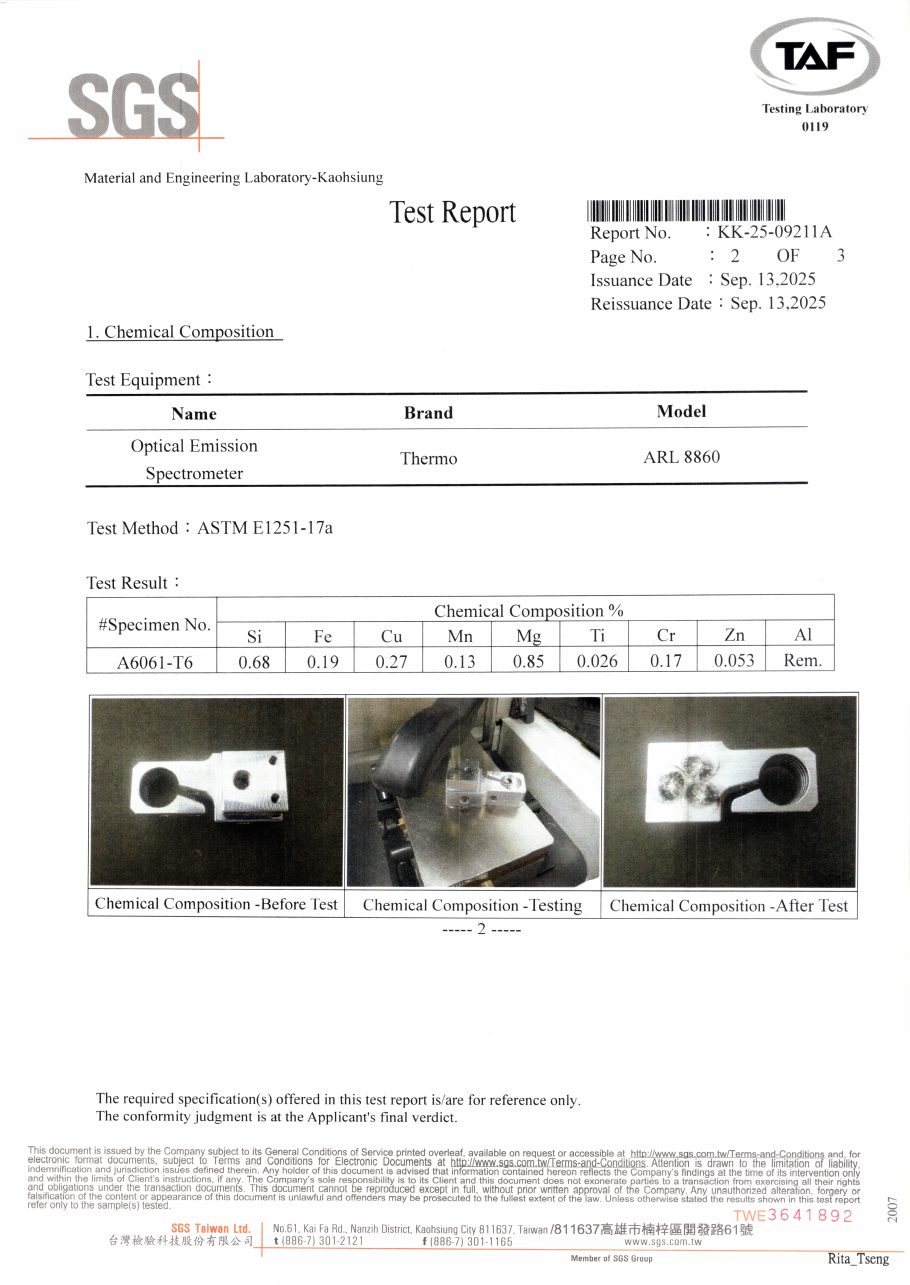
Report KK-25-09211A, chemical composition by optical emission spectrometer (Thermo ARL 8860), tested to ASTM E1251-17a. These are measured values from our own machined part — not a copy of a material supplier's datasheet.
| Element | 6061 limits (wt %) | Measured | Where it sits | |
|---|---|---|---|---|
| Silicon (Si) | 0.40–0.80 | 0.68 | within range, 85% of limit | |
| Iron (Fe) ● | max 0.70 | 0.19 | far below limit, 27% of limit | |
| Copper (Cu) | 0.15–0.40 | 0.27 | within range, 68% of limit | |
| Manganese (Mn) ● | max 0.15 | 0.13 | below limit, 87% of limit | |
| Magnesium (Mg) | 0.80–1.20 | 0.85 | within range, 71% of limit | |
| Chromium (Cr) | 0.04–0.35 | 0.17 | within range, 49% of limit | |
| Zinc (Zn) ● | max 0.25 | 0.053 | far below limit, 21% of limit | |
| Titanium (Ti) ● | max 0.15 | 0.026 | far below limit, 17% of limit |
● marks the impurity-indicator elements. Aluminium is the remainder. Specimen identified as A6061-T6.
The number we would point at
Iron: 0.19% measured against a 0.70% permitted maximum — roughly a quarter of the limit. Zinc at 0.053% against a 0.25% limit, and titanium at 0.026% against 0.15%, sit in the same territory.
Being inside the specification is the pass mark. Sitting this far inside it on the elements that accumulate through recycling is the part that is difficult to achieve with reprocessed feedstock.
In the interest of not cherry-picking: manganese is the closest to its limit, at 0.13% against a maximum of 0.15%. It is inside the specification, and we would rather show you the whole table than the three rows that flatter us.
Strength: the test that actually speaks to breakage
Composition tells you what the metal is. It does not tell you how much load it takes before it deforms or cracks — that comes from heat treatment as well as chemistry, and it needs a mechanical test.
The aluminium we machine from has been tensile tested to ASTM B557-15 on a Shimadzu UH-F300NXR universal testing machine, with an Epsilon 3542-050M-020-ST extensometer. Report KK-26-05352, 1 July 2026.
| Property | Specification minimum ASTM B221, 6061-T6 | Measured | Margin |
|---|---|---|---|
| Yield strength (0.2% offset) | 35.0 ksi | 50 ksi | +43% |
| Ultimate tensile strength | 38.0 ksi | 52 ksi | +37% |
| Elongation (G.L. 2 in) | 10% | 13% | +30% |
The specification minimum is the pass mark — the number below which the metal is not 6061-T6 at all. Every result clears it by a wide margin, and the elongation figure matters as much as the strength ones: 13% means the metal deforms before it fails rather than shattering.
Hardness
Hardness is the fast production check on whether heat treatment actually reached T6. Three readings from the mill certificate for heat 115061602, 12 August 2026:
| Reading 1 | Reading 2 | Reading 3 | 6061-T6 nominal |
|---|---|---|---|
| 61.9 HRB | 61.8 HRB | 61.6 HRB | 60 HRB |
All three sit above the nominal figure for the temper, and within 0.3 points of each other — consistent material, properly aged, not a lucky single reading.
Why we went looking for this
Battery terminals that crack are a real failure mode, and the usual root cause is metal that was sold as 6061 but never reached the strength that name implies. Composition alone would not have caught that — an alloy can have the right chemistry and still be soft if it was not heat treated properly.
So we asked for the mechanical numbers rather than assuming. They are above specification on every measure, which means the metal is not the weak link in this part.
Lead, cadmium, mercury and hexavalent chromium
You handle this part with bare hands, it lives in your vehicle, and it may well be within reach of children. The material was tested against the RoHS restricted-substance limits — report EKR26601067, 7 July 2026.
| Substance | Method | Limit | Result |
|---|---|---|---|
| Cadmium (Cd) | IEC 62321-5 | 100 mg/kg | Not detected |
| Lead (Pb) | IEC 62321-5 | 1000 mg/kg | 23.8 mg/kg |
| Mercury (Hg) | IEC 62321-4 | 1000 mg/kg | Not detected |
| Hexavalent chromium Cr(VI) | IEC 62321-7-1 | 0.13 µg/cm² | Not detected |
Three of the four were not detected at all. Lead was measured at 23.8 mg/kg against a 1000 mg/kg limit — about 2% of what is permitted.
Conductivity: what it measures, and what it does not
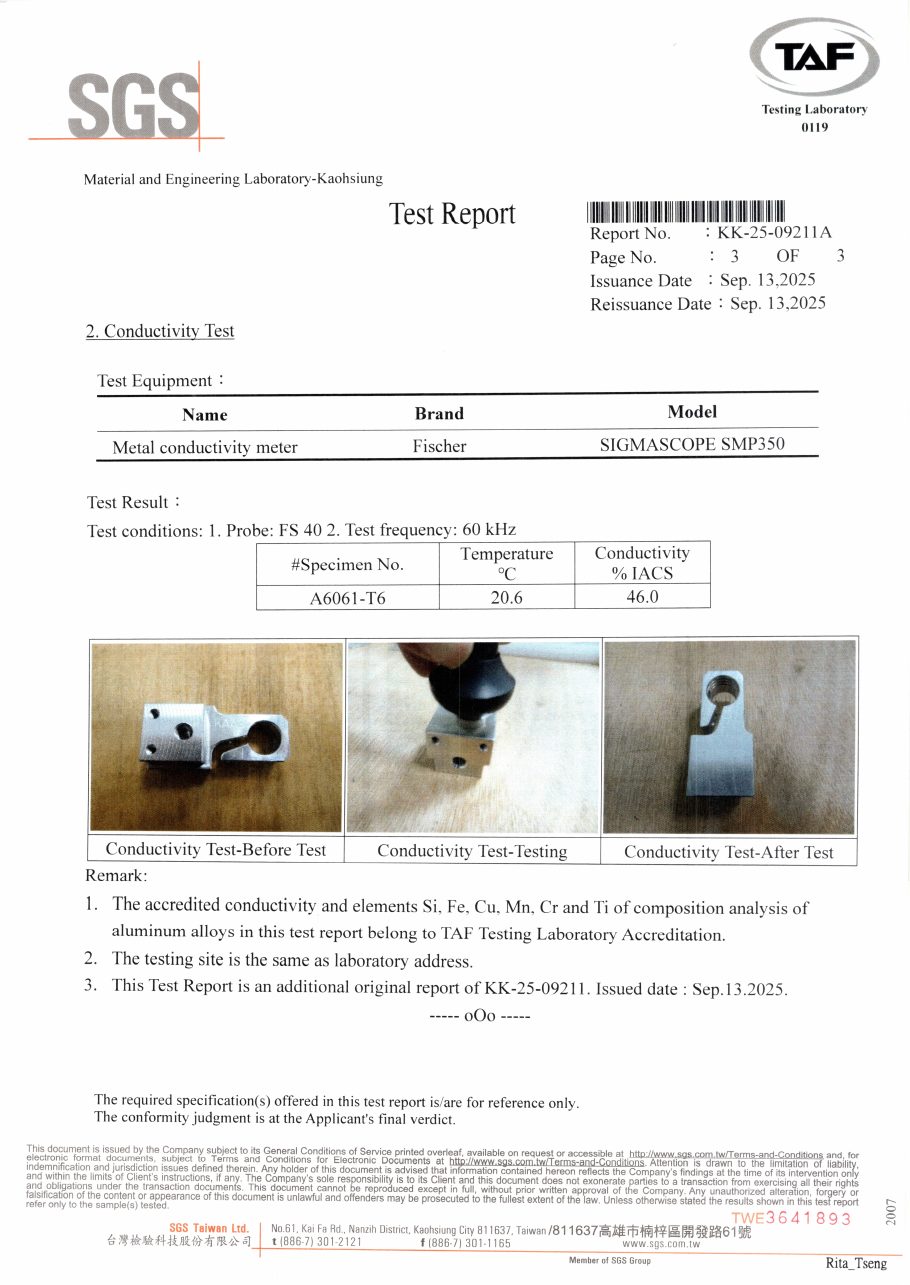
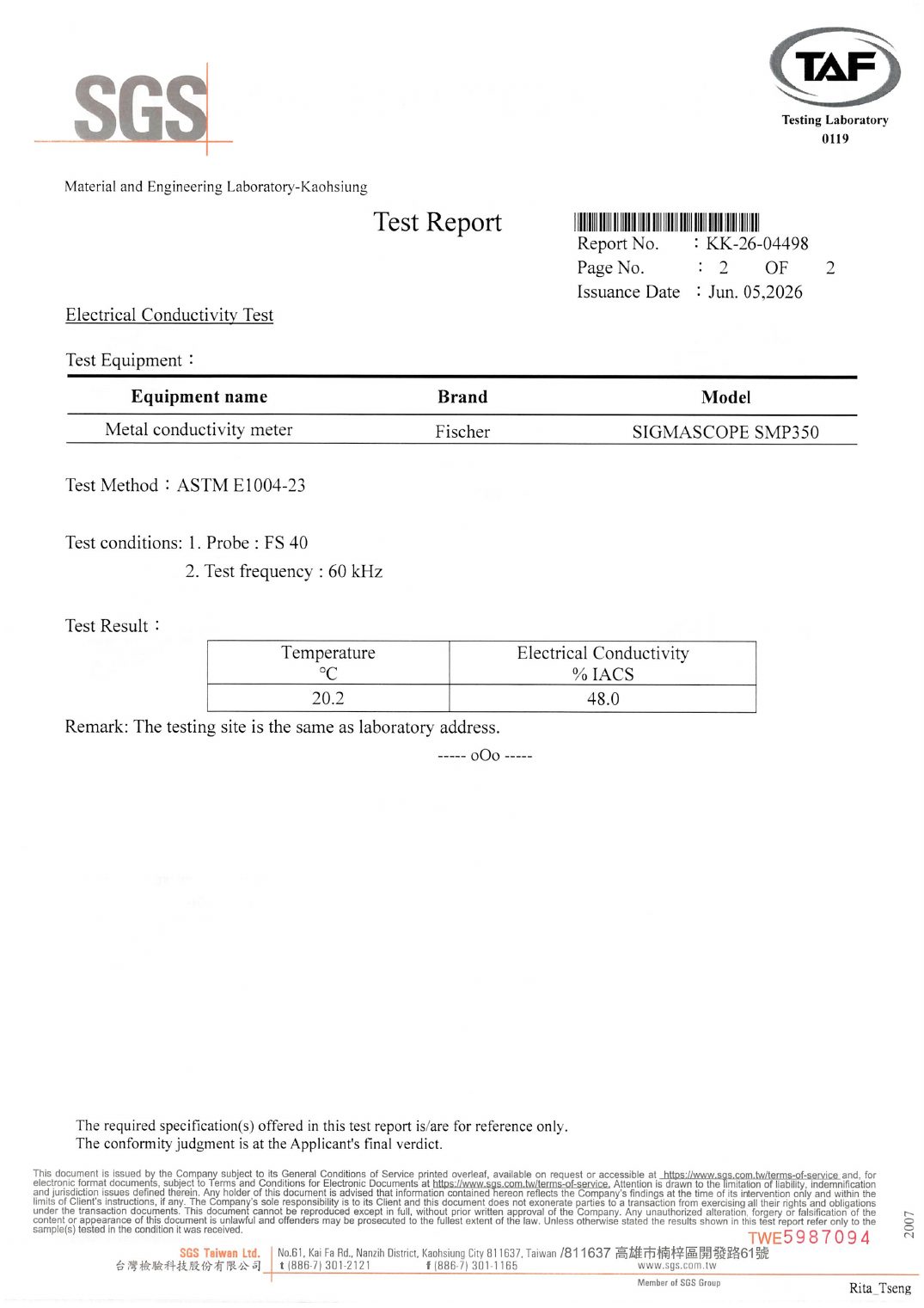
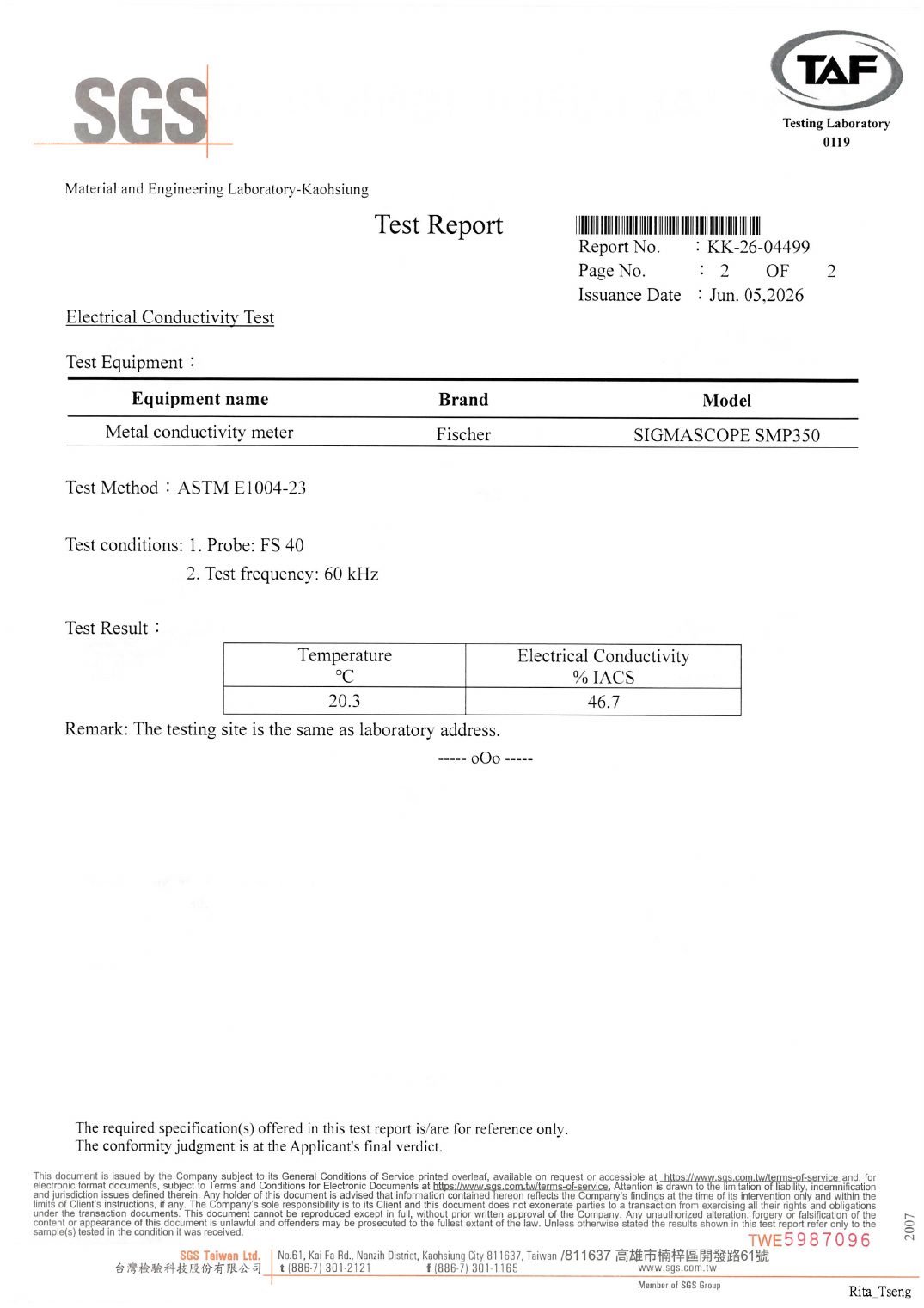
All three of our reports include an electrical conductivity test to ASTM E1004-23, measured with a Fischer SIGMASCOPE SMP350 using an FS 40 probe at 60 kHz. Because the method is identical across all three, the numbers are directly comparable with each other.
| Series | Report | Conductivity | Temperature |
|---|---|---|---|
| Eagle Series | KK-26-04498 | 48.0% IACS | 20.2 °C |
| FLEX Series | KK-26-04499 | 46.7% IACS | 20.3 °C |
| STING | KK-25-09211A | 46.0% IACS | 20.6 °C |
%IACS is the International Annealed Copper Standard: pure annealed copper is defined as 100%. A reading of 48% IACS means the metal conducts at 48% of that reference. At a battery terminal, where the entire job is getting current across a joint without losing voltage to resistance, this is the property that matters electrically.
These are good figures for a conductor. But conductivity is an electrical measurement, and we are not going to stretch it into a claim about strength — the two are not the same property, and in aluminium alloys of this family they do not even move in the same direction.
Where the evidence stops
We would rather draw this line ourselves than have someone else draw it for us.
- These test the material, not the finished terminal. The composition, tensile and hardness results describe the aluminium stock our parts are machined from. Machining does not change the temper, so the finished body is the same metal in the same condition — but the test pieces were bar and plate, not terminals, and we are not going to blur that.
- Strong metal is not the same as an unbreakable part. What the mechanical results establish is that the material reaches full T6 strength, so a failure would not be caused by soft or misdescribed metal. Geometry, wall thickness, how hard a fastener is torqued, and what the terminal is asked to carry all still matter. Anything can be broken if you try hard enough.
- They are test reports, not certifications. SGS measured what was submitted and reported the results. The reports state plainly that the conformity judgment is the applicant's. We are not claiming an SGS approval or endorsement.
- Samples were submitted by the party seeking the test. That is how commercial material testing works, and the reports say so on their face. What makes a result checkable is the report number, printed on every page.
- Results come from specific batches. The full chemical analysis is from report KK-25-09211A; the hardness figures are from one identified heat of material. Alloy chemistry varies slightly from heat to heat within the permitted ranges — that is normal, and it is why we describe this as the material platform rather than a guarantee that every atom is identical.
- We do not publish our supplier's identity, or our street address. The tensile and mill-certificate documents are issued in our aluminium supplier's name, and naming them would hand a sourcing route to the people copying our parts. Every number, method and report reference is published in full; only who we buy from is withheld.
Four questions to ask about any battery terminal
Not just ours. If you are comparing listings, these are the questions that separate a claim from a fact.
- Can they show a test report, or only the words? "Aircraft-grade" and "6061" cost nothing to type.
- Is there a report number you could quote back to the laboratory? A document with no traceable number is a picture.
- Does the report give measured values, or just say "pass"? Numbers can be checked against the specification. A pass cannot.
- Does the report cover the finished part, or a material certificate from someone else? A supplier's datasheet describes what was ordered, not what arrived.
We are publishing our answers to all four above. We think that is a reasonable thing to expect from anyone selling a part that clamps a live cable in a moving vehicle.
The reports
Every page of all three, as issued. Click any page to open it full size.
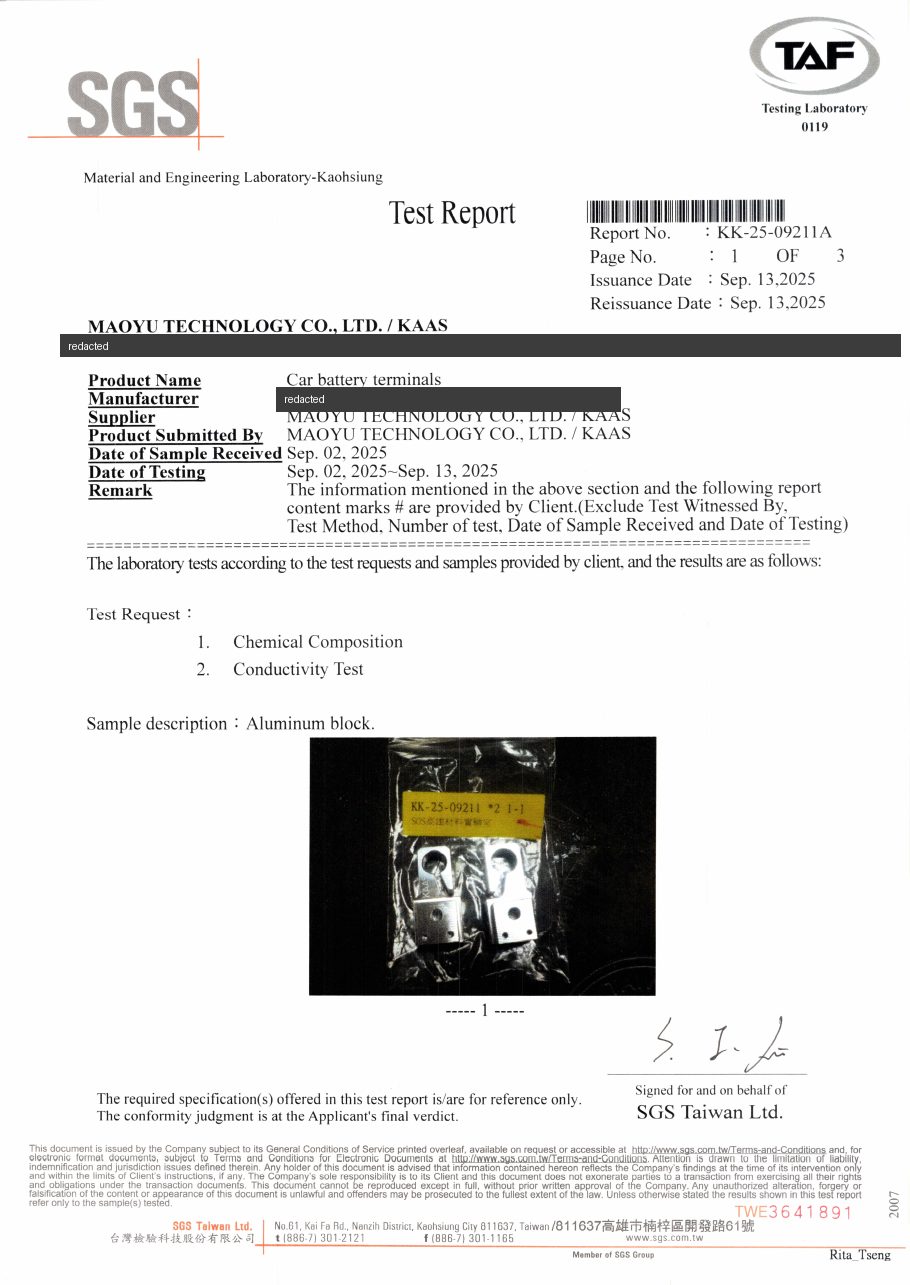
STING — report KK-25-09211A
| Report number | KK-25-09211A |
|---|---|
| Issued by | SGS Taiwan Ltd., Material and Engineering Laboratory — Kaohsiung (TAF Testing Laboratory 0119) |
| Issuance date | 13 September 2025 |
| Sample received | 2 September 2025 |
| Testing period | 2–13 September 2025 |
| Sample as described | Car battery terminals |
| Tests performed | Chemical composition + electrical conductivity |
| Conductivity result | 46.0% IACS at 20.6 °C |
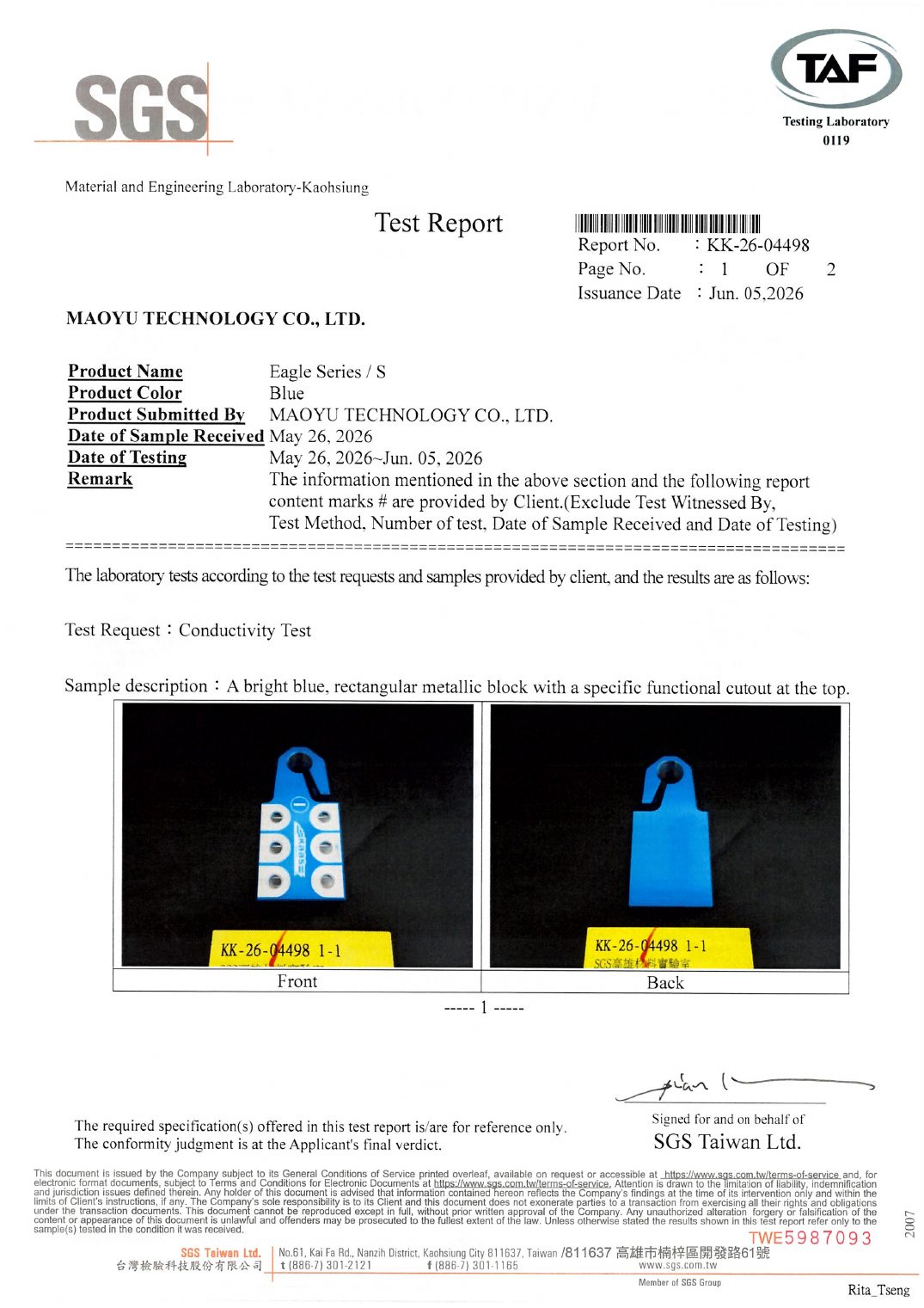
Eagle Series — report KK-26-04498
| Report number | KK-26-04498 |
|---|---|
| Issued by | SGS Taiwan Ltd., Material and Engineering Laboratory — Kaohsiung (TAF Testing Laboratory 0119) |
| Issuance date | 5 June 2026 |
| Sample received | 26 May 2026 |
| Testing period | 26 May – 5 June 2026 |
| Sample as described | Eagle Series / S |
| Sample colour | Blue |
| Tests performed | Electrical conductivity |
| Conductivity result | 48.0% IACS at 20.2 °C |
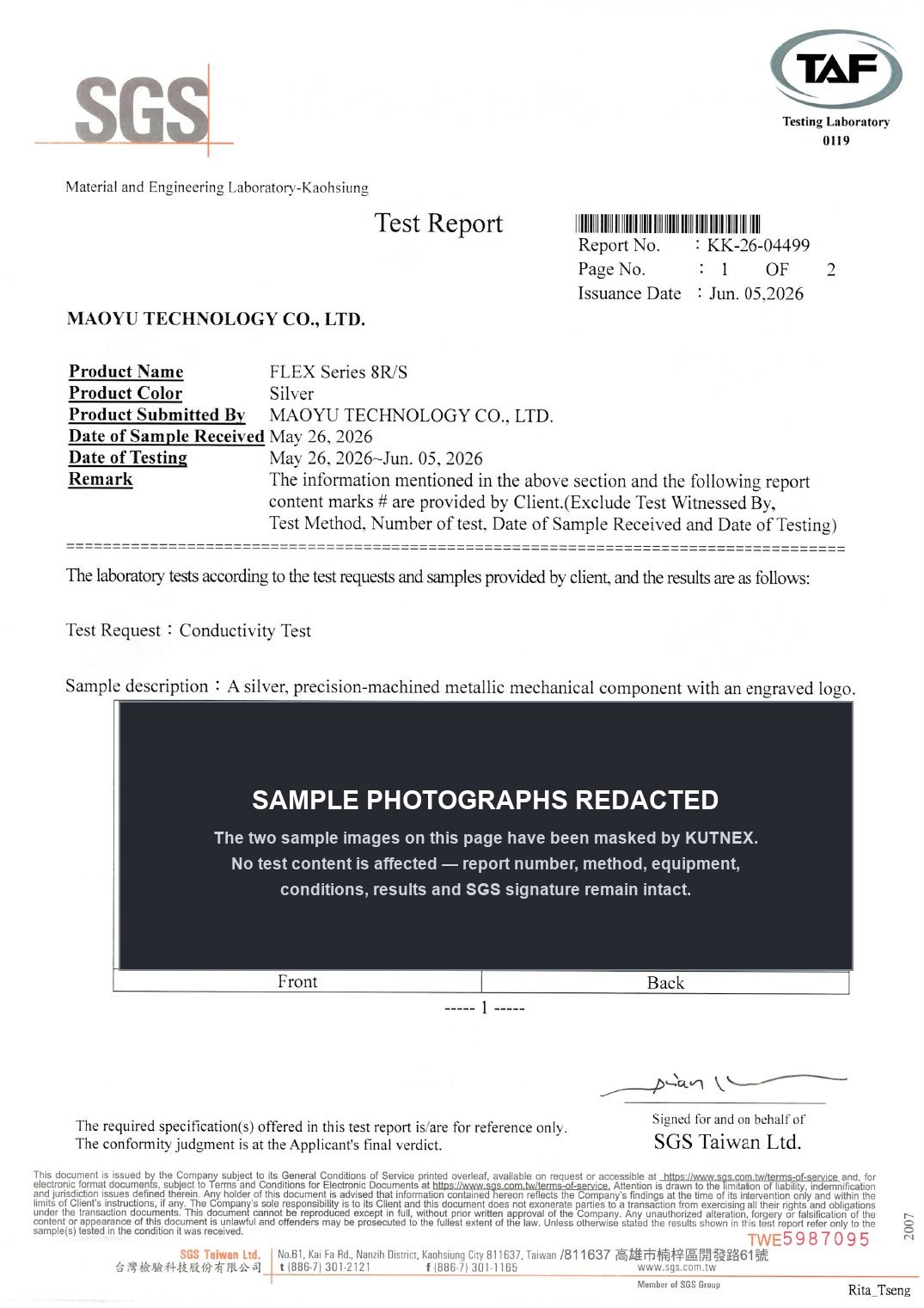
FLEX Series — report KK-26-04499
| Report number | KK-26-04499 |
|---|---|
| Issued by | SGS Taiwan Ltd., Material and Engineering Laboratory — Kaohsiung (TAF Testing Laboratory 0119) |
| Issuance date | 5 June 2026 |
| Sample received | 26 May 2026 |
| Testing period | 26 May – 5 June 2026 |
| Sample as described | FLEX Series 8R/S |
| Sample colour | Silver |
| Tests performed | Electrical conductivity |
| Conductivity result | 46.7% IACS at 20.3 °C |
Common questions
What does 6061 aluminium actually mean?
6061 is a specification, not a description. It sets a permitted range for eight alloying elements — for example silicon between 0.40 and 0.80 percent by weight, and iron no higher than 0.70 percent. Metal that falls outside those ranges is not 6061, whatever the listing says. The only way to know which you have is to test it.
Why does the alloy matter on a battery terminal?
A battery terminal is clamped under load, carries the highest current in the vehicle, and lives in a hot, vibrating, acidic environment. It is a mechanical part as much as an electrical one. Alloy and heat treatment determine how much clamping load the body can take before it deforms or cracks.
How can you tell recycled or off-specification aluminium?
Iron is the usual giveaway. It enters the melt from steel contamination in scrap and is very difficult to remove, so heavily recycled aluminium tends to run high in iron. Our measured iron is 0.19 percent against a permitted maximum of 0.70 — about a quarter of the limit.
Is the metal actually strong, or just the right chemistry?
Both, and they were tested separately. Composition shows the alloy is genuinely 6061. A tensile test to ASTM B557-15 shows it reaches full T6 strength: 52 ksi tensile and 50 ksi yield against specification minimums of 38 and 35. Hardness readings of 61.6 to 61.9 HRB sit above the 60 HRB nominal for the temper. An alloy can have correct chemistry and still be soft if it was not heat treated properly, which is why we asked for the mechanical numbers rather than assuming.
Is SGS certifying or endorsing your product?
No. These are test reports, not certifications. SGS measured the samples submitted and reported the results. The reports state on their face that the conformity judgment is the applicant's. We publish them so the measurements can be checked, not to imply an endorsement.
About the factory → See the range → Terminal dimensions →
Coming: Battery Terminal Fitment & Torque Guide
Post identification chart, the four measurements to take in your own engine bay, torque table, and a print-to-scale paper template you can hold against your battery before you order. Body dimensions are already published in the dimension table.
We are still measuring — every dimension in the guide is taken off the actual product rather than a drawing, and we would rather publish it late than publish a number we have not verified. There is no signup form here yet because we have nothing to send you yet. When the guide is ready this box becomes the place to get it.
Designed & Made in Taiwan
Every terminal is cut, anodised and inspected in our own factory. Not assembled here. Not finished here. Made here, from bar stock to boxed part.
The aluminium arrives with a mill certificate, gets tested before it is machined, and the results are published on this site rather than described. That is what the label is supposed to mean.